

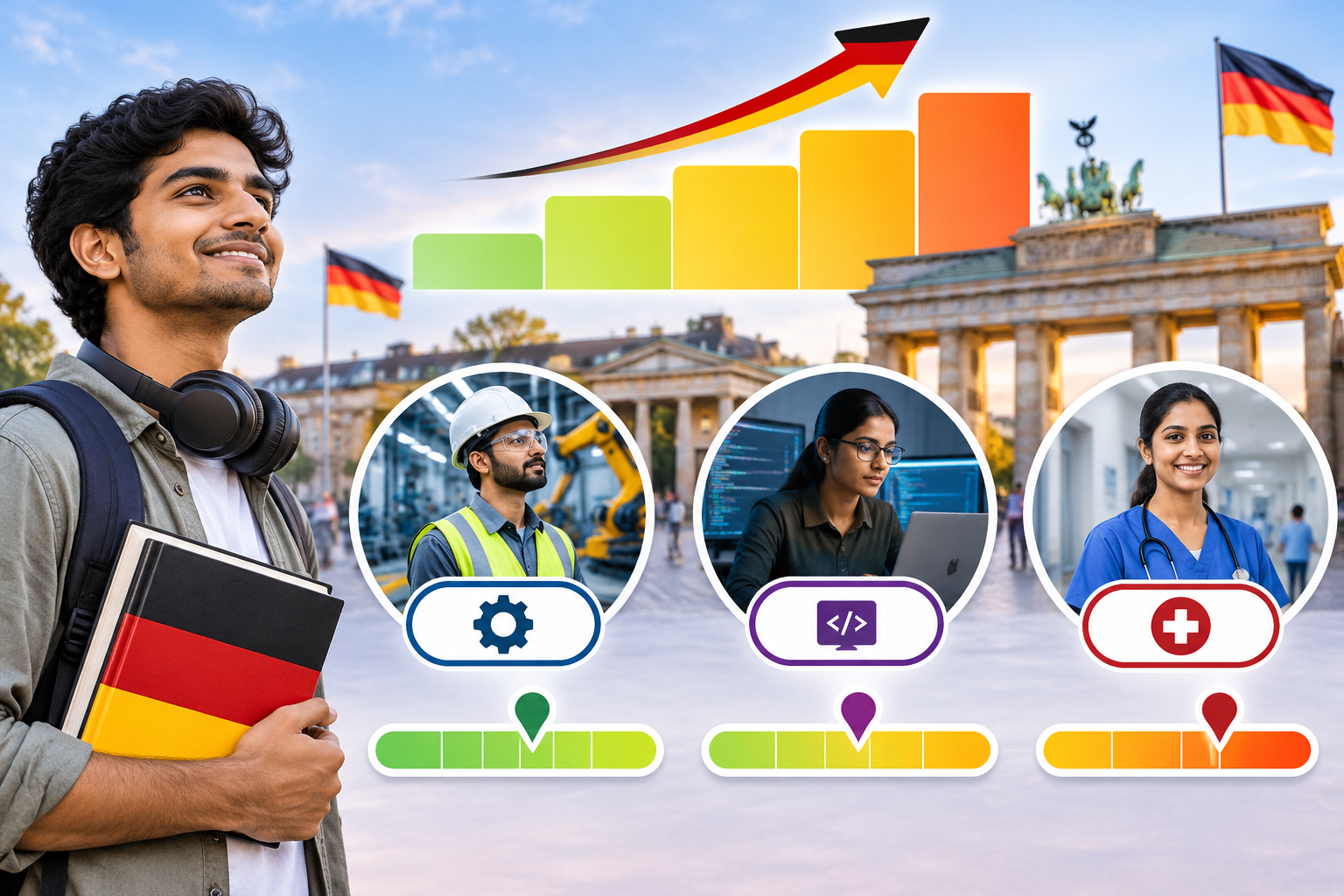
German for Jobs in Germany: Levels Needed for Engineers, IT & Nurses
Germany is a popular career destination for skilled professionals from India, particularly in engineering, information technology and healthcare. However, having the right degree and work experience is only part of the preparation. Understanding German can make it easier to communicate with employers, work with colleagues and settle into everyday life.
So, what level of German do you need to work in Germany? Is B1 enough, or should you aim for B2? The answer depends on your profession, the employer and whether your occupation requires professional recognition.
If you are planning to learn German language for jobs in Germany, this guide explains the language levels engineers, IT professionals and nurses should consider before applying.
Understanding German Language Levels: A1 to C1
German proficiency is measured through the Common European Framework of Reference for Languages (CEFR). It has six levels, from beginner to advanced.
- A1 – Beginner: Understand basic expressions, introduce yourself and communicate using simple sentences.
- A2 – Elementary: Handle familiar conversations, discuss everyday activities and understand commonly used phrases.
- B1 – Intermediate: Communicate independently in familiar situations, explain opinions and understand the main points of clear conversations.
- B2 – Upper Intermediate: Participate in detailed discussions, understand complex workplace communication and express ideas confidently.
- C1 – Advanced: Communicate fluently in professional and academic environments, including situations involving complex language.
For many international professionals, B1 is a useful practical milestone, while B2 provides stronger preparation for German-speaking workplaces.
1. German for Engineers: Is B1 or B2 Better?
Germany has opportunities across mechanical, electrical, civil, automotive, manufacturing and industrial engineering. International engineers may find positions in multinational companies where English is used for technical communication.
However, German becomes valuable when engineers need to coordinate with local teams, understand workplace instructions, communicate with suppliers or participate in meetings.
Recommended levels for engineers:
- A1–A2: A good starting point for basic conversations and everyday communication.
- B1: A practical target for interacting with colleagues, understanding routine instructions and managing daily life.
- B2: A stronger level for technical discussions, client communication, project coordination and roles involving regular interaction with German-speaking teams.
The German government notes that German is not generally mandatory for engineers to work in Germany, although it can improve their entry into the labour market and daily life. Some roles may also have specific recognition requirements, particularly when the professional title of engineer is regulated. Official German government guidance
If you are applying for engineering jobs from India, check the language requirements in individual job advertisements. A company may accept English for technical work but still prefer candidates who can communicate in German.
2. German for IT Jobs: Can You Work With English?
Germany's IT industry includes opportunities in software development, cloud computing, cybersecurity, data analytics, artificial intelligence and IT consulting.
Some international technology companies use English as their primary working language. This means IT professionals may find opportunities without advanced German proficiency, depending on the role and employer.
However, German can still offer an advantage. It helps when communicating with local clients, understanding business requirements, collaborating with non-technical departments and exploring opportunities beyond international teams.
Recommended levels for IT professionals:
- A1–A2: Useful for everyday communication and settling into Germany.
- B1: A practical target for workplace interactions and better integration.
- B2: Beneficial for client-facing IT roles, consulting, team leadership and positions involving regular German communication.
For some experienced IT professionals, German is not a legal visa requirement under the relevant professionally experienced worker route. However, this does not mean every employer accepts English-only applicants. Always check the job description and visa conditions that apply to your situation. Official German government guidance
3. German for Nurses: Why B2 Is Important
Nursing is different from many engineering and IT roles because it is a regulated profession in Germany. Nurses must meet professional recognition requirements and obtain the relevant authorisation to practise.
Communication is especially important in healthcare. Nurses interact with patients, doctors, families and hospital teams. They must understand instructions, explain procedures, record information and respond appropriately to patients' needs.
Recommended levels for nurses:
- A1–A2: The foundation for learning basic vocabulary and everyday expressions.
- B1: An important intermediate milestone while preparing for further language training.
- B2: A key target for professional recognition and nursing practice in Germany.
For internationally trained nurses, the official German government guidance generally specifies B2 German for the licence to practise, alongside recognised professional qualifications and other requirements. Requirements and procedures should always be checked with the relevant recognition authority. Official German government guidance
Learning German for nurses should include more than grammar. Healthcare vocabulary, patient conversations, symptoms, instructions and medical workplace communication are important parts of preparation.
4. Is German B2 Mandatory for Every Job in Germany?
No. One common misconception is that everyone needs B2 German to obtain a German work visa.
According to the official German government portal, a general work visa for qualified professionals and an EU Blue Card do not have a universal statutory German-language requirement. Some routes, such as recognition-related visas, have separate language conditions. Regulated professions may also require language proficiency for professional authorisation. Official German government guidance
It is important to understand the difference between three things:
Visa requirements: The language conditions attached to the specific immigration route you use.
Professional recognition: The language and qualification requirements set by the authority responsible for your profession.
Employer expectations: The language level a company prefers or requires for a particular position.
For example, an IT professional may qualify for a work route without proving German proficiency, while a nurse may need B2 for professional recognition. An engineer may not face a general language requirement but could still need German for a particular employer or regulated role.
Therefore, choose your target level based on your career and the exact route you plan to follow.
5. How to Plan Your German Learning Journey From India
If you are preparing for working in Germany from India, starting German before applying for jobs can give you more time to build confidence. A structured learning plan also helps you avoid rushing through important grammar and speaking skills.
Step 1: Build your foundation with A1 and A2
Start with pronunciation, greetings, sentence structure, vocabulary and everyday conversations. Practise introducing yourself, asking questions and talking about your education and profession.
Step 2: Develop independent communication at B1
At B1, focus on speaking more naturally. Practise describing your work experience, explaining your responsibilities, discussing schedules and understanding common workplace conversations.
Step 3: Work towards B2 for professional communication
At B2, develop your ability to participate in discussions, understand longer conversations and communicate clearly in more complex situations. Engineers can practise technical discussions, IT professionals can work on client communication, and nurses can focus on healthcare-related language.
Step 4: Prepare for a recognised language examination
Depending on your employer, recognition authority or application route, you may need an accepted certificate. Commonly recognised examination providers include Goethe-Institut, telc and ÖSD. Confirm which examination and level the relevant authority accepts before registering.
Step 5: Practise German alongside job preparation
Prepare your German CV and interview introduction where appropriate. Learn vocabulary related to your profession and practise answering questions about your qualifications, experience and career goals.
6. Why Choose an Online German Course?
An online German course can be a convenient option for students and working professionals in India who want to prepare for international career opportunities.
A structured course can help learners progress through grammar, vocabulary, listening, reading, writing and speaking. Live interaction and regular practice are particularly useful because language learning requires active communication, not just memorising words.
When selecting a German course online, look for a clear A1-to-B2 learning pathway, opportunities to practise speaking, level-appropriate study material and guidance for examination preparation.
Most importantly, choose a learning schedule that you can follow consistently alongside your college, job or professional responsibilities.
Start Learning German for Your Career Goals
Whether you are an engineer exploring manufacturing opportunities, an IT professional considering international technology roles or a nurse preparing for professional recognition, German can play an important role in your career journey.
A1 and A2 help you build the foundation, B1 supports independent communication, and B2 is a valuable target for many professional situations. Nurses should pay particular attention to B2 requirements for recognition, while engineers and IT professionals should check individual employer and visa conditions.
At Divine Daivik Diksha, learners can explore online language learning as part of their preparation for international opportunities. Start with the right level, practise consistently and work towards the German proficiency that matches your career ambitions.
Frequently Asked Questions
1. Which German level is required to work in Germany?
There is no single German level required for every job. Engineers and IT professionals may find English-speaking roles, while B1 or B2 can improve workplace communication. Nurses generally need B2 for professional recognition and authorisation.
2. Is German B2 required for engineers in Germany?
B2 is not a universal legal requirement for engineers. However, it can be useful for technical discussions, project coordination and roles involving German-speaking clients or teams.
3. Can I get an IT job in Germany with English only?
Yes, some IT companies and international teams hire English-speaking professionals. However, German can increase your opportunities and make everyday communication easier.
4. Is B1 German enough for nurses in Germany?
B1 may be a useful learning milestone, but internationally trained nurses generally need B2 German for professional recognition and the licence to practise. Requirements should be confirmed with the relevant authority.
5. Can I learn German online from India?
Yes. Online learning allows students and working professionals to study German from India. A structured course with speaking practice, grammar lessons and examination preparation can help learners progress through A1, A2, B1 and B2.


